Pages

Thursday, 15 October 2015

Man Booker Review: A Brief History of Seven Killings by Marlon James

As everyone has said, the title of Marlon James' third novel must be ironic as there are far more than seven deaths and, unless you can happily devour a lengthy Victorian novel in a day, 680 pages is hardly brief. At least Victorian novels are serialised, although James does break the novel up into several parts, each one dedicated to a certain day. It begins on 2nd December 1976 as plans are afoot to shoot Bob Marley, who is only referred to as 'the Singer' which makes him appear far more than the simple title suggests, and concludes on March 22nd 1991 where the ramifications of the events are still felt. However, the novel is not a straightforward chronology, especially as it jumps ahead almost decades between the third, fourth and final section. Moreover, the myriad of characters that populate the novel and narrate their own experiences make the novel less a detailed timeline than a web of time attempting to cover multiple personal lives and make them coherent.
Despite that description, the novel is immensely readable and only confusing when it gets into particularities of Jamaican politics, but that is probably more my ignorance than a fault in the novel. It helps that it engages with themes and ideas that I'm particularly interested in, though that also prevents the novel from being totally alienating in addressing a non-Western culture. (Again, this is my ignorant white-guy perspective coming in, which James ruthlessly dissects as will be noted below. I merely wanted to point out my foibles, but I'm getting better, I promise!)

As you might gather from the title, A Brief History of Seven Killings addresses the nature of history and its permanence, but in a particularly interesting way. Ghosts figuratively and literally appear throughout the novel. (Although how literal a ghost can be is a different discussion entirely.) The novel begins with the suggestion that "the dead never stop talking and sometimes the living hear." The helplessness (and pointlessness) of this scenario hints at the oncoming tragedies that happen again and again no matter what the characters do, or at least so it seems. Much like another Man Booker Nominee Pigeon English, the spiritual aspects are drawn upon but only briefly referenced; they are on the edges of the 'real' world and often unacknowledged by the characters. For the most part they're completely unaware of this presence as they are busy dealing with their own lives, as they try and survive, never mind live a worthwhile life. The spectral characters provide some near-overwrought commentary but the characters themselves are perfectly capable of deep philosophical thought that derives from their own experiences; James appears to be consciously avoiding dry philosophical and social commentary in this way. One of the finest examples is from Nina, whose misfortunes stack up so high it is almost unbearable yet she is determined to prove her own worth regardless:


the quickest way to not live at all is to take life one day at a time. It’s the way I’ve discovered to not do a damn thing. If you can break a day down into quarters, then hours, then half hours, then minutes, you can chew down any stretch of time to bite size…If I don’t want to think about my life, I don’t have to think about life at all, just hold on one minute, then two, then five, then another five, before you know it, a month can pass and you don’t even notice because you’ve only been counting minutes.
This Beckettian notion of existence in a world where nothing happens most of the time is thus grounded in an incredibly profound way while not simply making the characters mouthpieces for an author's message. The characters come first so any sense of shock is dependent on the reader's own views. The novel is constantly challenging the reader and itself as it delves deep into the character's psyches so that their personal revelations feel universal in a very specific sense (which is more than this blog seems to be). Here's an example of what I mean:
This is the first mistake God make. Time. God was a fool to create time. It’s the one thing that even he run out of. But me beyond time. Me in the now, which is now which is also then. Then is also soon and soon might as well be if.
There is a lot to unpick in this novel, but another theme that stood out for me that is related to the tragic nature of time is how it can be represented. The novel is essentially a series of monologues and, while the characters do cross each other's path, they are mostly isolated from each other. Not only does this make each character individualistic and memorable, it demonstrates how when attempting to recreate history - stories of the past - there will be contradictions and difficulties to have the facts communicate on the same level. To skip to the end and ook at the Acknowledgments where Marlon James explains some of the process of writing the novel which, naturally, is very revealing and eloquent about such difficulties:
The problem was that I couldn't tell whose story it was. Draft after draft, page after page, character after character, and still no through line, no narrative spine, nothing. Until one Sunday, at W.A. Frost in St. Paul, when I was having dinner with Rachel Perlmeter, she said what if it's not one person's story?
[...]
I had a novel, and it was right in front of me all that time. Half-formed and fully formed characters, scenes out of place, hundreds of pages that needed sequence and purpose. A novel that would be driven only by voice.
His initial concern permeates into the novel and with this knowledge in mind, it can often seem like the author is talking rather than the character, to somewhat distracting effect such as here:
Somebody need to listen to me and it might as well be you. Somewhere, somehow, somebody going judge the quick and the dead. Somebody goin' write the judgment of the god, because I am a sick man and a wicked man and nobody ever wickeder and sicker than me...Somebody going write about this, sit down at a table on a Sunday afternoon with wood floor creaking and fridge humming but no ghost around him like they around me all the time and he going write my story. And he won't know what to write, or how to write it because he didn't live it, or know what cordite smell like or how blood taste when it stay stubborn in your mouth no matter how much you spit it. He never feel it in the one drop.
However, this may be a harsh criticism because, as I said earlier, James always ensures that the character is at the forefront: "I am a sick man and a wicked man and nobody ever wickeder and sicker than me"; Demus' (the character speaking) judgement of himself reveals the uncertainty which he is unable to dispel. But the best example of James adding metafictional flourishes about writing a complicated story to his characters is Alex Pierce, a American journalist working for Rolling Stone.

James resists all the stereotypes such a character would inevitably invite by showing Pierce chastising himself for putting himself out of his depth even though that is a crucial part of his job. While Pierce is subject to a particular racial criticism as he attempts to document life in Jamaica without becoming "just another white man who has the presumption to think he can school black people on their roots," the parallel between James and Pierce is clear; Pierce becomes James' agent in the 'real world', falling into the traps James predicts he himself would fall into, although he embraces the fact that he is writing a novel by making such traps more extreme and delightfully horrible then they possibly would be in reality. One of these traps is a particular section I love but as it is right at the end of the novel, I will say no more. 

On a relevant note, though, I want to pick up on Michiko Kakutani's much quoted description of Brief as "like a Tarantino remake of “The Harder They Come” but with a soundtrack by Bob Marley and a script by Oliver Stone and William Faulkner, with maybe a little creative boost from some primo ganja." I am only aware of two of the works he references and, unsurprisingly if you've read this blog, it is the comparison to Tarantino that seems most accurate. That is, the best of Tarantino where the narratives are connected, sometimes closely-knitted, sometimes passingly (as in Pulp Fiction) rather than disjointed and more sketch-like (like Inglorious Basterds and, to a lesser extent, Kill Bill).

I feel that Kakutani was referencing to the violence in these films though when bringing it up in his well-researched if spoilery review, as well as the way the characters speak. Both are casual, aggressive and brutally shocking - this is an 18 rated book easy but all the more exhilarating for it.* James is having fun but this is not a jokey take on serious issues; it reflects that even the most atrocious of acts and language can have a joke as part of it, especially when they are so common in Jamaica: "This country, this goddamn island, is going to kill us." The casual descriptions of these events are perfectly suited to the style of the book as each character narrates their thoughts as well as the actions. Subsequently, there are no holds barred - interesting to note not only the casual use of nigger or 'naegger' but how it is often uncommented on or dismissed as a completely unshocking word to use.

I could go on describing and quoting the characters and their fascinating stories: Nina, who begins the second part of the novel with a shocking opening ("You can't really know how it feels, just knowing deep down that in a few minutes these men will rape you") but remains a self-determined individual throughout the world that continues to threaten and destroy her; the various gang-members with their own motives and desires that inevitably causes conflicts between them, whether they are in the same gang or not; Papa-Lo who often directs his thoughts to "all nice and decent people" as he explains how he is "the baddest man in Copenhagen City. But badness don’t mean nothing anymore."

The confusion of voices is fairly minimum as they are so vivid that they can speak themselves and are soon recognisable. Helpfully, the book begins by listing the 'Cast of Characters' which I ended up bookmarking as it proved to be a useful refresh as we went from narrator to narrator.

In the end, it is the boldness and confidence that shines through the book and makes it a great read. Yes, it is often challenging and wince-inducing; it takes its time to flesh out the characters a some length so is hardly a quick read either. But I never felt I was trudging through it and already I have the desire to re-read it rattling around my brain to the sound of ska and reggae music - seriously, it's broadened my music palate so much and I am grateful for that alone. But James shows no fear in deconstructing, and occasionally mocking, these somewhat high-and-mighty literary ideas with comments like "The problem with a book is that you never know what it's planning to do to you until you're too far into it." Never is that more true then with this book, a worthy winner with its fluidity of tone and ambitious but engaging ideas making it a real standout book.

*As a little coda to this comment, I keep on seeing criticism that reference PC e.g. 'this play is gloriously un-PC'. Now I hate to be that guy, but this is such a dated phrase that it is almost PC in itself - a way to disguise saying something is disgusting or horrific or offensive etc. Those are perfectly fine words to use - use them and avoid being as prudish as you claim PC is. Banish the term to the dustbin of 'words used to the point of uselessness'.

Friday, 18 July 2014

The need to be repulsed (American Psycho by Brett Easton Ellis)

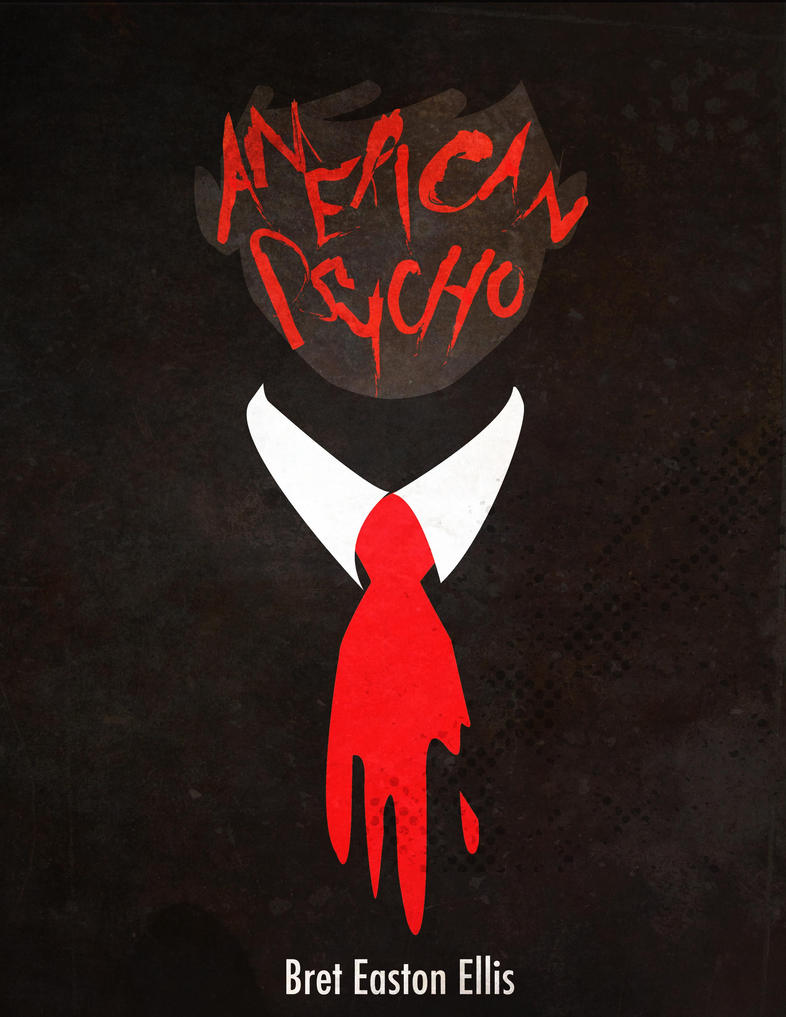
Finishing American Psycho does not mean finishing with American Psycho. I finished it several days ago and it still lingers in my head. And I don't know if it's in a good way or a bad way or someplace in between. The novel is narrated by 'yuppie' Patrick Bateman, a businessman who feels dislocated from the world around him and his business colleagues. Surrounded by expensive items, Patrick feels himself struggling to be content with the materialistic and money-driven conversations and lifestyles of his co-workers. So obviously he finds himself having horrifically violent and sexual thoughts which every so often he actually performs, which are described in explicit, visceral and excruciating detail.

So just to make it clear. Reading American Psycho is not a pleasurable reading experience by any means. However, I have always felt that a book can be interesting even if it's not fun or is especially difficult to read. Drawing from my post last week, I described Headlong Theatre's production of 1984 as "the perfect combination of intellectual stimulation and emotionally charged drama" and obviously, it is possible for something to be one of those things rather than both. Some books can be fun but not deep, some books can be interesting but not enjoyable, and others (those that tend to have some sort of legacy and timelessness) can be both. And that's fine by me.

But with American Psycho, I found my belief challenged. I can recognise the intelligence behind this book - Patrick's violent actions contrast with his monotonous day-to-day life; his obsession with materialistic value (he explains at considerable length his opinions on Whitney Houston, Genesis, and Huey Lewis and the News; he goes through every detail of his clothing and where he got it from; his morning routine centers around particular brands of hygiene products) paradoxically means he can never be satisfied; his callousness towards others is evident through his brutal and sadistic acts and his casual watching of The Patty Winters Show, a show about people who have suffered in their lives who he never engages or sympathises with but treats as entertainment. These are all interesting and well thought out ideas, but the violent acts themselves are so repulsive that it is difficult to try and keep reading the book from a solely intellectual approach.

Thus I was conflicted - there's a lot to admire in this book but it is so difficult to keep reading. Many times I had to stop and take a breath before carrying on. And even when there isn't a violent or sexually explicit scene, the world Patrick inhabits is depressingly materialistic and self-obsessed, although at least the blatant satire of this culture allows for some laughs. But it still left me asking the question, as I got closer and closer to finishing it: do I actually like this book?

It was as I was mulling over this question that I read Will Self's article from May. Now usually I find Self can be a tad over-blown and, (speaking as a pot about a kettle), pretentious at times. However, there's nothing wrong with his style of writing per se and his argument that audiences don't like difficult books is convincing. Not sure if I think it can be applied to the general public as a whole (but few arguments can), but it struck a chord with me as I wrestled with my opinion on American Psycho.

There can be no doubt that it is a difficult book. While the violence is horrific, it is clearly deliberately so and, to an extent, it is more understandable than the topics of conversation that Bateman finds himself involved in. His colleagues continuously and unashamedly objectify women, and describe them in terms of their attractiveness and sexiness - whether they're a 'hardbody' or not is often queried before women can be invited to dinners. They also casually speak derogatorily of small people (at a Christmas party, small waiters are hired to be elves), ethnic minorities, homosexuals, and the homeless. Apologies for sounding so politically correct but it is a direct antithetical response to how they are described in the book.

Now, not for one moment do I believe that the author is homophobic, racist, sexist etc. While it is not immediately obvious (it is several pages before he refers to himself as 'I'), the novel is written from Patrick Bateman's perspective and his narration is more coloured, as it were, than the other characters would be. Strangely enough, as I said above, Patrick is not the most despicable character despite his violent behaviour. He's certainly the most extremely violent, but to be honest I found them all as reprehensible as each other.

It is possible that this novel does what Catcher in the Rye does (a novel that has some very interesting, if unexpected, similarities to Ellis') by filtering the world through its self-centered character and subsequently making it seem worse than it really is. Nevertheless, it is the only version of this world we have and it seems clear to me that we're not meant to like it. Indeed, as I write this that I'm reminded of my greatest pet peeve about criticisms of Catcher in the Rye, and probably many other books: many say they can't like the book because they don't like Holden Caufield.

To me, it is obvious you're not meant to not like Holden but I still love the book, because Holden is so interesting even when I disagree with almost everything he says and hate him for the stupid things he does. But just because I don't like, agree or even sympathise with the content doesn't mean that I would consider a book bad. Maybe it's because I've been reading since I was little and I'm studying English Literature at university, but I think a book can interest me despite what it is about. A great book (and moreover a great film, piece of music, TV show, play, etc.) is one that allows you to understand and see another perspective on something that you are unfamiliar with or uncomfortable with.

As I said before, this book has lingered in my head days after I read it. While predominately it is the horrifically violent scenes, the brutal and dark comedy of the book also lingers. Indeed it is this satirical commentary that is the focus of the reviews quoted in my edition. Certainly, I can't deny it is there but I think that it is perhaps too obvious. The book is repetitive which, while justified, does occasionally get dull and make me want to say to Ellis 'Yes, I get the point, can we move on now?'. There is the argument that its repetitiveness is part of its point, but subsequently it treads a fine line between being clever and being pretentious.

To its credit, the book doesn't hold anything back and so strongly gets its point across, but that does mean it can feel like nothing happens. (Although I have to say the ending is appropriately anti-climactic that doesn't undo the good stuff in the book). So I don't think I'll easily resolve this debate, but that means I hesitate to recommend this book. If you don't like reading sexually explicit or horrifically violent scenes or read purely for superficial fun, I would suggest avoiding it. If you like being challenged in your reading and are willing to confront the evils mankind is capable of, then go for it.

I don't regret reading this book and in the end, it's made me think about things in ways I couldn't have considered before. And that has got to be a plus.

Friday, 11 July 2014

Theatre review: Hotel (National Theatre); 1984 (Playhouse Theatre)

First off, I saw these shows several weeks ago and they both close by the end of August. So bad timing on my part, sorry. If you want a quick answer of whether you should get tickets for these shows ASAP, the short answer is yes. (You have until 2nd August for Hotel, while 1984 is on for lightly longer: 23rd August. Both links are where I got my tickets from and I highly recommend them. They arrived promptly and were decent prices for the seats I got.)

Once you've done that, feel free to stick around and read my thoughts. I promise no spoilers, although this is difficult with Polly Stenham's latest play, Hotel.


Safe to say, Stenham's career is on an increasingly high trajectory following her award-winning debut That Face in 2007, which she wrote at 19 and starred some actor nobody's heard of called Matt Smith. Give it three years...
While in comparison to Smith Stenham's star has taken longer to shine, it is still impressive that in seven years she has written three successful plays at the Royal Court and now has a play at the National Theatre, with numerous film scripts soon to be added to her repertoire. While I have read all her previous plays, I became aware of her too late to see any of them. I recommend reading all of them although you may find, as many critics point out, that she covers similar themes and, if you're mean hearted, the same plot: a middle class family dealing with difficult problems that threaten to splinter that family dynamic. (I promise they're a lot more interesting then that sounds).

Hotel begins, as if deliberately to annoy those critics, with a dysfunctional middle class family, with the son and daughter keeping a secret from their father, who has got his politician wife into a career-threatening scandal. They all go to a hotel resort on an African island (I may not have been paying close enough attention, but I don't think they specify where). The holiday doesn't go to plan and I won't go any further, as the play tautly races through its 80+ minutes running time as shocking events unfold.

This intense speed is helped by the enclosed space, where you are incredibly close to the action. Even those in seats above me (I was in the stalls) were far from detached from the action. The Shed (or as I believe it is officially called for legal reasons, The Temporary Theatre) is a fantastic space that from the start pledged to exhibit new, experimental theatre and having now been in it, I can see why. The set is amazingly detailed, which makes sense as it is all set in the hotel room, further enhancing the claustrophobic atmosphere.

You might have noticed I started commenting on the set first, which is usually a bad sign in a review. And I have to say I think this is Stenham's weakest play, but despite that it's still a tense, intelligent piece of work. Maybe it's because I'm used to her writing now, but it did feel like she was using the same tricks again although on a more politically charged subject matter. This change of focus, while refreshing, does mean that her tendency for didactic speeches, which are usually written with enough conviction to not be an issue, seems less subtle.

Despite that, I gasped several times and felt uncomfortably tense pretty much throughout. Having only read Stenham's writing, it was a completely different experience seeing it spoken and acted out right in front of me. Her writing is so visceral and angry that when given to good actors (the ensemble cast were all great) you can't help but get carried away with it. Maria Aberg's direction keeps the tension palpable and the shocks are rarely exactly as you expect. It was an intense experience that left me breathless but didn't quite hold together once I thought about it some more. But overall I'm very glad I saw this energetic, gripping piece of theatre that gives its audience lots to think about and a fascinating subject to debate about.

I'm so glad I gave myself a few hours just to wonder round London and take in some fresh air before I plunged into another world of nightmares - the world of 1984, Headlong Theatre's acclaimed adaptation of Orwell's famous novel.


Interestingly enough, both productions chose not to have an
interval, which meant I had a pretty intense day of theatre-going experience from two demanding plays. But thankfully the time flowed quickly and there was a minimal amount of fidgeting in my seat.

Sadly, 1984 wasn't the total experience I wanted. I was fairly high up in the dress circle and so the top of the video screen (which interacts with the live action beautifully) was cut off. It didn't totally ruin the experience, but I have to admit it was lessened slightly. Also, the play was briefly disrupted when someone in front of me nearly passed out because of the bright lights that flashed repetitively during the Room 101 sequence, although I have to admit it made those scenes that bit more uncomfortable. But in all seriousness, there wasn't a noticeable warning for those who react badly to strobes, so here it is.

No matter where you sit, though, it will be difficult not to be blown away by this production. If you're intrigued by how exactly they manage to dramatise a book that spends so long in Winston's troubled mind, then there's plenty of reviews that spoil exactly how they do it. Having read a couple of these, one of the most eerie sequences was ruined for me so I'm not going into detail. However, even that sequence still gave me chills, as did the entire production. It is the perfect combination of intellectual stimulation and emotionally charged drama which means every scene has incredible power. For example, the transition to Room 101 was absolutely stunning, one of the best things I've seen in theatre, that I admired as a technical achievement but also terrified me as Winston's world collapses around him.

As the web page for the production explains, the story of 1984 is bookmarked by a group of historians looking at the book as an historical artifact. Not only does this refresh the story and aid in translating it into a stage play, it allows the play to address our reaction to the novel as well as the novel itself. While it spells it out in its penultimate line, it's message still leaves an impact that is at once thoughtful and unsettling. Safe to say, without its outstanding ensemble cast, who so eerily convey the dystopian world without over-exaggeration, the play would lack its power.

While far from perfect experiences, I was absolutely engrossed and incredibly impressed by these productions. Headlong Theatre have created one of, if not The, best book-to-stage adaptations I've ever seen and is absolutely unmissable. Glad I finally got to see it, as well as Hotel, which has ticked off a box for me in finally seeing a Polly Stenham play, of which hopefully I will see many more.

Friday, 8 November 2013

Film Roundup: Real life dramas (The Fifth Estate, Captain Phillips)

Wow, been a while since one of these huh? Blame the hectic university lifestyle.

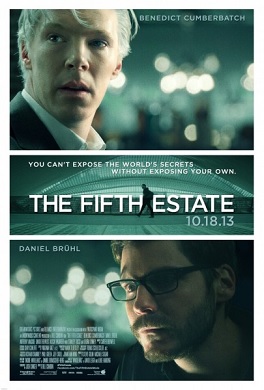
This week, there has been two films that deviate from a typical biopic and attempt to turn the true stories into thrillers. The Fifth Estate clearly owes a huge debt to The Social Network, which successfully made the backroom in-fighting about the creation of Facebook one of the most gripping films of the year. The visual style of The Fifth Estate has clearly been influenced by it but is nonetheless stunning. The visualisations of the workings of the Internet are jawdropping. But is this a case of style over substance? You would hope not considering the story at the heart of the film - the founding of Wikileaks, which shook up the world in a way that is still affecting us now.

The first half of the film focuses on Julian Assange (Benedict Cumberbatch, or as Jeremy Jahns brilliantly describes him 'Cumberbleach') founding Wikileaks and gradually building up its reputation with the help of Daniel Schmitt (Daniel Bruhl).* As you'd expect Cumberbatch is extraordinary, capturing the authentic vocal inflections and dominating presence that Assange appears to have. Bruhl is less captivating but then this isn't a particular surprise. For one, he is by far the least interesting character and, not surprisingly, the one we are more familiar with. This means that the relationship they have in the film comes across much like Nick Carraway and Gatsby in The Great Gatsby; the central character, fascinated by an elusive and uncommunicative figure, finds himself over his head when involved in the unusual events the mysterious figure is involved in.

Unfortunately, this isn't as good as it sounds. Great as Cumberbatch is, we never get a foothold of his character. This is not necessarily a problem except that as soon as the major events occur in the second half of the film, we are expected to understand his character enough to feel the dramatic importance of the revelations. As such, the film seems to be in two minds about Assange - whether to treat him as an elusive, Gatsby-like figure, or to make him a fully rounded character to lock heads with Schmitt over important decisions. The very final scenes then go on a completely different track altogether. Perhaps all this shows how difficult Assange is to place as a character. This would be fine in a straight biopic but it is just frustrating within the drama the filmmakers appear to be trying to make, and to be honest, I'm not even that sure what type of film they're trying to make now I'm trying to write about it.

This indecision also affects Schmitt. The films attempt to go into thriller territory in the latter half relies upon him selling the threat. However, the character is so constantly confused and in the dark about everything, we end up feeling as clueless as he does. Despite Bruhl's best efforts, the character does not leave a lasting impression. However, at least he isn't as poorly treated as Alicia Vikander is playing Schmitt's girlfriend, Anke Domscheit. I had to look up her character name so unimpressionable was her character. In fact, I'm not 100% sure I've got the right character. She is set up to be Schmitt's moral conscience, someone to remind him how his work is affecting the world. But in the film, she exists to do specific acts: shout at Schmitt, be angry at Assange, mope occasionally, and have sex with Schmitt. What an absolute waste of a character. Not many people seem to be talking about the sexual politics of this film, but I'll just say that when the prominent female character spends most of her scenes kissing the protagonist and being abandoned by him post-sex, it becomes an unfortunately major problem.

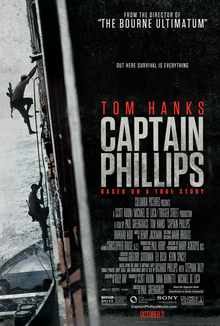
Thankfully, Captain Phillips does not leave such a disappointing taste afterwards. It just leaves you in awe and shock. A much preferable reaction I'm sure we'd all agree. Marine Captain Richard Phillips is undergoing a typical cargo mission when he strays too close to pirate territory and finds his ship under threat. I'll avoid any more plot details because frankly, it's unnecessary to go into it. The film is a thriller, hence some people may be able to see where it is going even if they didn't know the true story. I have to say I was always on tenterhooks. While a part of me was thinking, "It'll be fine. It's a thriller with Tom Hanks. Everything will turn out alright", the film constantly made my stomach plunge as Phillips is put to an ever increasingly desperate situation. By the time the credits came up, I needed a deep breath.

So clearly, the film is an excellent thriller. But as Paul Greengrass did so well in United 93 (another film which is difficult to endure but oh so rewarding), the thriller aspects are given more heft by fantastic drama. The two captains oppose, reflect and feed into each other. Everyone is saying how fabulous Tom Hanks and I'm not going to deny that. He is excellent and plays a role as I have never seen him before. So vulnerable, so flawed. But he is matched and at times outstaged by the truly excellent Barkhad Abdi as the pirate captain. In fact, the whole crew is superb, and are so believable and well rounded that a part of me wanted them to, not necessarily succeed, but come out all right.

While both films boast excellent performances throughout the entire cast, I felt that Captain Phillips brought me in confidently and somewhat brusquely into the situation. Not for one moment did I have absolute certainty of what would happen next or even what I could have done in that situation. It was engaging and involving in the way The Fifth Estate wasn't with all its bombasity and self-importance. Greengrass knew exactly what he was doing; I feel Bill Condon had more of a struggle with his material, which is understandable. A hijacking film seems easier to pull off as a drama then the Wikileaks scandal. But that would be too dismissive of Captain Phillips, which is truly an excellent film and everyone should go see.
If you need a Dumb Person's Guide to Wikileaks, as I did, The Fith Estate serves fine. It is a perfectly efficient film but not a particularly memorable one.


*I would just like to note that obviously the intricate details about the founding and running of Wikileaks is constantly debated. I am summarising the story of the film rather than trying to explain the reality, of which I know little of, as I'm about to explain...

Friday, 18 October 2013

The Luminaries by Eleanor Catton

I had a big ambitious series of posts planned for last week, where I'd cover the entire Man Booker Prize shortlist. Unfortunately, university and, to be frank, laziness meant I didn't actually, really, properly read the shortlist. I read half, which is better than last year, as well as a few from the longlist. I'm sure I'll put up reviews soon of those I read (see if you can guess) but luckily I devoted a lot of time to the longest book on the shortlist which ended up being the winner, as I guessed it would be. So, what did I actually think of it?

Well, as I said I felt that the second book from Eleanor Catton was most likely to win. This is mostly to do with the sheer ambition of the book. The 800 odd page novel begins with Walter Moody accidentally interrupting a secret meeting between a group of gentleman with a story to tell. Before he can tell it though, he finds himself involved in the investigation of a number of mysterious events: a murder, a suicide attempt, disappearances and stolen money.

It is impossible to ignore the sheer length of the book but far from off-putting, Catton uses it expertly to create a sprawling epic. Following various characters each with their own story at various points in time, it is impossible not to admire the sheer skill Catton has. Every character is memorable with detailed and vivid characterisation, and very quickly you are able to tell each character apart and not muddle them up into a bunch of caricatures. Catton uses the complex and lengthy narrative to flesh out every area of the characters which massively benefits as the story unfolds.

The intricate links and connections of the stories are expertly done. She avoids giving ll the information straight out but teases enough out for you to feel very clever when you spot a link. Rather than a dull world building exercise, the book is an engrossing mystery which explores Catton's version of 1866 New Zealand. Within an atmosphere of intrigue and excitement, Catton gradually reveals more and more of the world so that you can really appreciate the depth and vivacity of it.

However, I wouldn't say that this is a perfect book. Like a previous Man Booker nominee Pigeon English, an attempt at bringing a supernatural element into this grounded world feels forced. Once the main plot is over, the astrological implications gain more focus and these become less interesting, unfortunately tarnishing the fascinating character studies that conclude the book. There is also an interrupting narrator, which beyond giving a pleasing metafictional touch, doesn't really add anything to the novel.

But these are minor quibbles in what is a truly extraordinarily ambitious book which I'm sure will be rewarding on re-readings. Despite the length of it and the time it took to read it, a part of me is really tempted to jump back in again to Catton's glorious world, gripping mysteries and written in gorgeous prose to boot. A worthy winner and well worth investing your time in.