Pages

Tuesday, 8 March 2016

Asking for It by Louise O'Neill | Banging Book Club

In short, this is a book that tackles our desire to cling to our preconceptions of rape and how we should deal with it as a society and as individual people. But I have more to say about this, I think. Though if it wasn't for a new YouTube based bookclub (mentioned in the title), I don't know if I would have.

First of all, I have to say that as well as encouraging me to not be so prudish/picky about what I read, the Banging Book Club (led by three of the most interesting and intelligent YouTubers) provides a great starting point for discussions whether it was an off-the-cuff comment in their non-spoiler videos (I found Lucy's description of the book as 'a cautionary tale' interesting and worthy of more discussion) to the in-depth discussions on the podcast. In fact, I had started writing this when I listened to the podcast and I now regret not waiting - for now, it produced some Incidental Thoughts (see bottom of this post) but future posts on books from Banging Book Club will be written post-podcast.

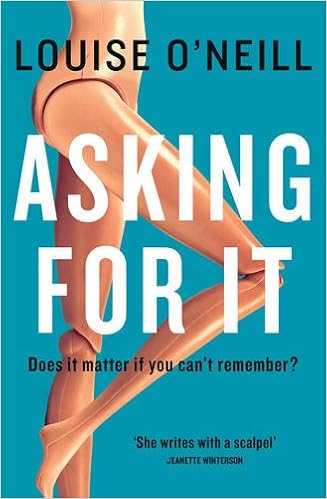
So my initial thoughts were coloured by my slow-reading - having read the first part set 'Last year' I got a distinctly American Psycho vibe (I'll explain more below), which was then brutally stripped away when I reached the second section and the stark realism of 'This year'. As always, it's taken me a while to get to a synopsis of the book, but frankly I think the book itself tells you everything you need to know from its cover
I would like it if this happened to someone else. I would like it if someone else was ruined too. I wouldn't be alone.
For those of you not familiar with American Psycho, there's a good summary here (oh and it's by me! how funny!) but the reason I thought about it is that both novels use the first-person narration to create an entirely superficial world where true emotions are bubbling underneath exploding through in scenes of sexual violence. Now, in terms of the violence, Asking for It is far more palatable and less nauseating than Ellis provides in his novel but is no less uncomfortable. The event is so heavily signposted from the cover onwards that when it happens there is a horrifying sense of inevitability; almost as if Emma was asking for it. The novel is clearly playing on this sense of inevitability and addresses it head on in the second half as Emma transforms before our eyes:
Maybe she [her mother] wishes that I had died too. Would that have been an easier grief than this, looking at me every day and knowing that this was only a shell, that Emmie, the real Emmie, was never coming back and that there was a new Emma that she had to learn to love all over again? 
While I said there's a shift into realism - and there is, in that we dive deeper into Emma's psyche rather than the fleeting hints and clues buried under her desire to be popular - it's only that the flashy superficiality of Emma's life is replaced by a 'realist' aesthetic. It is more strip-backed but is no more honest as there are no easy or honest conversations - whereas before there was a routine as part of a game everyone was in on, here it is more stilted as Emma claims, "I don't know what to say. Tell me my lines please" and that her mother 'doesn't like it when I [...] go off script." This need to find the right way to talk about rape and the stigma that affects how we talk about it is something that concerns me particularly and I think is interestingly addressed in the novel. Rather than lecture about the morality of how we should treat rape victims (and how damaging that label can be regardless of good intentions), it remains observational in presenting its reality as Emma evidently struggles to cope with how she is treated, whether it is through supportive hashtags or judgemental condemnations - it's all unhelpful and raises the question: "When did we all become fluent in this language that none of us wanted to learn?" Even writing this review, I'm worried about writing the wrong thing or, even worse, falling into the cliched phrases that surround this topic and so are becoming increasingly useless as they become more generalised. Is there a right language for discussing this? I can't answer this, and neither does O'Neill, instead she goes for honesty - she, and Emma unsurprisingly, show an awareness of how her victimisation is treated and represented, and to me, that is the novel's greatest strength: addressing the issue head-on rather than trying to judge as pretty much every single character does.


Right from its front cover, the novel shows an engagement with what seems to be the ongoing (and seemingly never-ending) social issue of rape, consent and why its all got so complicated.  O'Neill uses the phrases that sound so cliche and stereotypical yet all too familiar in order to attack them (and the attitudes they represent) with a scalpel (to borrow Jeanette Winterson's description of O'Neill's style) that it is also necessary to at least address them in any exploration of this subject matter. What is particularly impressive is how Emma remains a three-dimensional character with O'Neill just avoiding her becoming a passive victim in her own story, even as she explains how
 my brain is crammed up with that word and those photos and those comments (her tits are tiny, aren't they?) and I don't have any room for anything else.
Her life has been consumed by this event so yes she is passive, but she is by no means willing to be a part of this narrative even as there are no signs of escape.

Saying all that, to develop the above description, while there is a fierce yet controlled satirical edge to O'Neill's writing which warrants Winterson's cover-friendly quote, I don't think it is as delicate as the phrase suggests - this is a pointed attack and there are plenty of scars made by O'Neill. She does not hide her her horrified viewpoint on the situation Emma finds herself in which I'm in no position to deny or praise in terms of accuracy. What that means though is while I am on O'Neill's side, I feel some subtlety was lost and the novel felt less realistic and more polemic. Although perhaps my unease really comes from the fact that the novel sits between those two positions - I never felt lectured but then I couldn't quite believe in the reality of the novel either. (NB While Emma's situation is not exclusive to women, I doubt being a man helps with my identification problem which I notice few female readers claim to see)

And perhaps that's the point. We can't understand this situation because it is so remote from our lives even though it isn't as remote as we think - indeed our careless attitude is precisely the problem. Seeing it from Emma's perspective means we naturally sympathise with her struggles while never being sure how malicious the intent is by those who cause her suffering. No doubt this is an uncomfortable read, but like American Psycho, it is made somewhat palatable by its satire. But this is not feel-good satire - to walk away from this book feeling educated and smug at seeing a new perspective ignores what the book tries to do. This is harsh satire, stuff that is painful to laugh at but the urge is there regardless. This is satire with bite and proof that satire doesn't have to be uproariously funny as long as it takes a side swipe at the world it is depicting.

One last repetition to end this review on: A provocative take on an uncomfortable subject matter that reminds us we should never be comfortable discussing this subject, which is why we must.

Incidental Thoughts from the podcast
  • It struck me that there is a famously unlikeable literary character called Emma - Jane Austen's Emma. Makes me wonder if O'Neill's Emma could be read as a modernised version of Austen's Emma who is unlikeable but not unsympathetic, except she is not given a happy ending.
  • I found Hannah's question about whether someone could read this and think she was asking for it fascinating - I think it could be very easily read as a one-dimensional reactionary polemic, either in glorifying victim shaming with a 'she had it coming' attitude or glorifying victim shaming with a 'pity the poor rape victim because she's a rape victim, not because she's a human being' attitude. (I realise I've probably expressed myself poorly there, but hopefully the two extremes are clear)
  • I can't help wondering if the novel is being manipulative - I mean all art ism but developing from that above point, does the subject matter dominate the novel too much? Is it too much of a social issues novel? Is that even a criticism? As I say, it is certainly provocative so the fact it raises so many questions, I can only consider a good thing.

Thursday, 15 October 2015

Man Booker Review: A Brief History of Seven Killings by Marlon James

As everyone has said, the title of Marlon James' third novel must be ironic as there are far more than seven deaths and, unless you can happily devour a lengthy Victorian novel in a day, 680 pages is hardly brief. At least Victorian novels are serialised, although James does break the novel up into several parts, each one dedicated to a certain day. It begins on 2nd December 1976 as plans are afoot to shoot Bob Marley, who is only referred to as 'the Singer' which makes him appear far more than the simple title suggests, and concludes on March 22nd 1991 where the ramifications of the events are still felt. However, the novel is not a straightforward chronology, especially as it jumps ahead almost decades between the third, fourth and final section. Moreover, the myriad of characters that populate the novel and narrate their own experiences make the novel less a detailed timeline than a web of time attempting to cover multiple personal lives and make them coherent.
Despite that description, the novel is immensely readable and only confusing when it gets into particularities of Jamaican politics, but that is probably more my ignorance than a fault in the novel. It helps that it engages with themes and ideas that I'm particularly interested in, though that also prevents the novel from being totally alienating in addressing a non-Western culture. (Again, this is my ignorant white-guy perspective coming in, which James ruthlessly dissects as will be noted below. I merely wanted to point out my foibles, but I'm getting better, I promise!)

As you might gather from the title, A Brief History of Seven Killings addresses the nature of history and its permanence, but in a particularly interesting way. Ghosts figuratively and literally appear throughout the novel. (Although how literal a ghost can be is a different discussion entirely.) The novel begins with the suggestion that "the dead never stop talking and sometimes the living hear." The helplessness (and pointlessness) of this scenario hints at the oncoming tragedies that happen again and again no matter what the characters do, or at least so it seems. Much like another Man Booker Nominee Pigeon English, the spiritual aspects are drawn upon but only briefly referenced; they are on the edges of the 'real' world and often unacknowledged by the characters. For the most part they're completely unaware of this presence as they are busy dealing with their own lives, as they try and survive, never mind live a worthwhile life. The spectral characters provide some near-overwrought commentary but the characters themselves are perfectly capable of deep philosophical thought that derives from their own experiences; James appears to be consciously avoiding dry philosophical and social commentary in this way. One of the finest examples is from Nina, whose misfortunes stack up so high it is almost unbearable yet she is determined to prove her own worth regardless:


the quickest way to not live at all is to take life one day at a time. It’s the way I’ve discovered to not do a damn thing. If you can break a day down into quarters, then hours, then half hours, then minutes, you can chew down any stretch of time to bite size…If I don’t want to think about my life, I don’t have to think about life at all, just hold on one minute, then two, then five, then another five, before you know it, a month can pass and you don’t even notice because you’ve only been counting minutes.
This Beckettian notion of existence in a world where nothing happens most of the time is thus grounded in an incredibly profound way while not simply making the characters mouthpieces for an author's message. The characters come first so any sense of shock is dependent on the reader's own views. The novel is constantly challenging the reader and itself as it delves deep into the character's psyches so that their personal revelations feel universal in a very specific sense (which is more than this blog seems to be). Here's an example of what I mean:
This is the first mistake God make. Time. God was a fool to create time. It’s the one thing that even he run out of. But me beyond time. Me in the now, which is now which is also then. Then is also soon and soon might as well be if.
There is a lot to unpick in this novel, but another theme that stood out for me that is related to the tragic nature of time is how it can be represented. The novel is essentially a series of monologues and, while the characters do cross each other's path, they are mostly isolated from each other. Not only does this make each character individualistic and memorable, it demonstrates how when attempting to recreate history - stories of the past - there will be contradictions and difficulties to have the facts communicate on the same level. To skip to the end and ook at the Acknowledgments where Marlon James explains some of the process of writing the novel which, naturally, is very revealing and eloquent about such difficulties:
The problem was that I couldn't tell whose story it was. Draft after draft, page after page, character after character, and still no through line, no narrative spine, nothing. Until one Sunday, at W.A. Frost in St. Paul, when I was having dinner with Rachel Perlmeter, she said what if it's not one person's story?
[...]
I had a novel, and it was right in front of me all that time. Half-formed and fully formed characters, scenes out of place, hundreds of pages that needed sequence and purpose. A novel that would be driven only by voice.
His initial concern permeates into the novel and with this knowledge in mind, it can often seem like the author is talking rather than the character, to somewhat distracting effect such as here:
Somebody need to listen to me and it might as well be you. Somewhere, somehow, somebody going judge the quick and the dead. Somebody goin' write the judgment of the god, because I am a sick man and a wicked man and nobody ever wickeder and sicker than me...Somebody going write about this, sit down at a table on a Sunday afternoon with wood floor creaking and fridge humming but no ghost around him like they around me all the time and he going write my story. And he won't know what to write, or how to write it because he didn't live it, or know what cordite smell like or how blood taste when it stay stubborn in your mouth no matter how much you spit it. He never feel it in the one drop.
However, this may be a harsh criticism because, as I said earlier, James always ensures that the character is at the forefront: "I am a sick man and a wicked man and nobody ever wickeder and sicker than me"; Demus' (the character speaking) judgement of himself reveals the uncertainty which he is unable to dispel. But the best example of James adding metafictional flourishes about writing a complicated story to his characters is Alex Pierce, a American journalist working for Rolling Stone.

James resists all the stereotypes such a character would inevitably invite by showing Pierce chastising himself for putting himself out of his depth even though that is a crucial part of his job. While Pierce is subject to a particular racial criticism as he attempts to document life in Jamaica without becoming "just another white man who has the presumption to think he can school black people on their roots," the parallel between James and Pierce is clear; Pierce becomes James' agent in the 'real world', falling into the traps James predicts he himself would fall into, although he embraces the fact that he is writing a novel by making such traps more extreme and delightfully horrible then they possibly would be in reality. One of these traps is a particular section I love but as it is right at the end of the novel, I will say no more. 

On a relevant note, though, I want to pick up on Michiko Kakutani's much quoted description of Brief as "like a Tarantino remake of “The Harder They Come” but with a soundtrack by Bob Marley and a script by Oliver Stone and William Faulkner, with maybe a little creative boost from some primo ganja." I am only aware of two of the works he references and, unsurprisingly if you've read this blog, it is the comparison to Tarantino that seems most accurate. That is, the best of Tarantino where the narratives are connected, sometimes closely-knitted, sometimes passingly (as in Pulp Fiction) rather than disjointed and more sketch-like (like Inglorious Basterds and, to a lesser extent, Kill Bill).

I feel that Kakutani was referencing to the violence in these films though when bringing it up in his well-researched if spoilery review, as well as the way the characters speak. Both are casual, aggressive and brutally shocking - this is an 18 rated book easy but all the more exhilarating for it.* James is having fun but this is not a jokey take on serious issues; it reflects that even the most atrocious of acts and language can have a joke as part of it, especially when they are so common in Jamaica: "This country, this goddamn island, is going to kill us." The casual descriptions of these events are perfectly suited to the style of the book as each character narrates their thoughts as well as the actions. Subsequently, there are no holds barred - interesting to note not only the casual use of nigger or 'naegger' but how it is often uncommented on or dismissed as a completely unshocking word to use.

I could go on describing and quoting the characters and their fascinating stories: Nina, who begins the second part of the novel with a shocking opening ("You can't really know how it feels, just knowing deep down that in a few minutes these men will rape you") but remains a self-determined individual throughout the world that continues to threaten and destroy her; the various gang-members with their own motives and desires that inevitably causes conflicts between them, whether they are in the same gang or not; Papa-Lo who often directs his thoughts to "all nice and decent people" as he explains how he is "the baddest man in Copenhagen City. But badness don’t mean nothing anymore."

The confusion of voices is fairly minimum as they are so vivid that they can speak themselves and are soon recognisable. Helpfully, the book begins by listing the 'Cast of Characters' which I ended up bookmarking as it proved to be a useful refresh as we went from narrator to narrator.

In the end, it is the boldness and confidence that shines through the book and makes it a great read. Yes, it is often challenging and wince-inducing; it takes its time to flesh out the characters a some length so is hardly a quick read either. But I never felt I was trudging through it and already I have the desire to re-read it rattling around my brain to the sound of ska and reggae music - seriously, it's broadened my music palate so much and I am grateful for that alone. But James shows no fear in deconstructing, and occasionally mocking, these somewhat high-and-mighty literary ideas with comments like "The problem with a book is that you never know what it's planning to do to you until you're too far into it." Never is that more true then with this book, a worthy winner with its fluidity of tone and ambitious but engaging ideas making it a real standout book.

*As a little coda to this comment, I keep on seeing criticism that reference PC e.g. 'this play is gloriously un-PC'. Now I hate to be that guy, but this is such a dated phrase that it is almost PC in itself - a way to disguise saying something is disgusting or horrific or offensive etc. Those are perfectly fine words to use - use them and avoid being as prudish as you claim PC is. Banish the term to the dustbin of 'words used to the point of uselessness'.